Beforetheapocalypse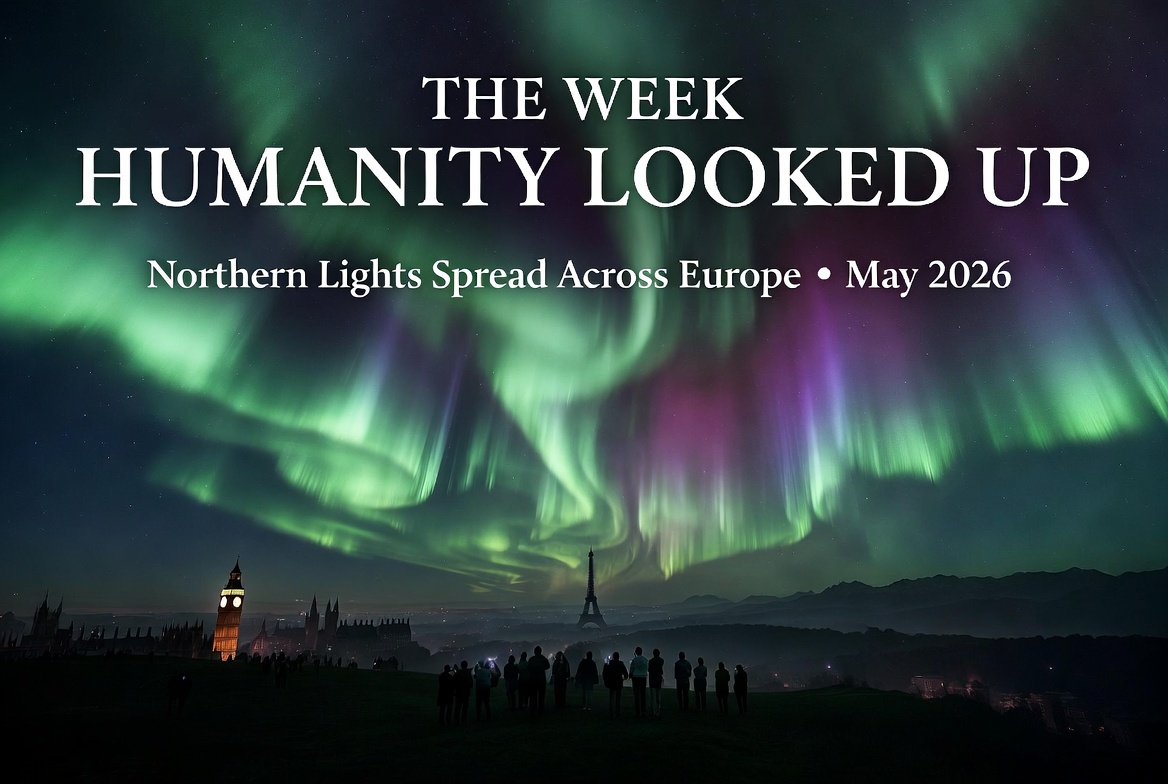
Recovered web article — May 2026
Before everything changed, people were still searching the sky for beauty.
In May 2026, millions of people across Europe were preparing to step outside at night, phones in hand, hoping to witness a rare natural phenomenon: the Northern Lights appearing far beyond their usual home near the Arctic Circle.
Search engines filled with the same questions:
“When can I see them?”
“Will they reach my country?”
“How do I photograph the aurora?”
This is what the world cared about that week.
The Solar Storm That Made People Look Up
Astronomers had detected a powerful solar storm heading toward Earth. Charged particles from the Sun were racing toward the planet, expected to collide with Earth’s magnetic field and ignite shimmering lights across the night sky.
The event was described as rare, beautiful, and must-see.
At the time, this kind of news felt exciting, not ominous.
People set reminders for the middle of the night.
The Countries Waiting in the Dark
Forecast maps spread quickly across the internet. If skies stayed clear, the aurora might be visible in:
- United Kingdom
- Ireland
- Germany
- Poland
- Netherlands
- Belgium
- Northern France
- Scandinavia
Even parts of Central and Eastern Europe hoped for a glimpse.
For many, it would have been the first time seeing the aurora in their lifetime.
Instructions From a Different World
Articles like this one shared simple advice:
Go outside between 10 PM and 3 AM.
Find darkness.
Look north.
Bring a camera.
Millions planned night trips away from cities, chasing a glow in the sky.
It was an ordinary kind of hope.
Social Media Before the Silence
People posted guides and tutorials:
- Use night mode on your phone
- Try long-exposure photography
- Watch for green and purple lights moving slowly across the horizon
Communities formed around the excitement.
Photos from earlier aurora displays went viral.
Everyone wanted their own picture.
It was one of the most searched topics on the internet.
The Sun Was Entering Its Active Phase
Scientists explained that the Sun had entered the most intense part of its 11-year solar cycle. More solar storms were expected in the coming years.
At the time, this was framed as good news for skywatchers.
More auroras.
More rare nights.
More reasons to look up.
A Small Snapshot of What Mattered
This article is preserved as a reminder of what occupied people’s attention in May 2026:
They planned midnight trips.
They checked weather apps.
They worried about clouds.
They hoped for clear skies.
They were excited about lights in the sky.