Beforetheapocalypse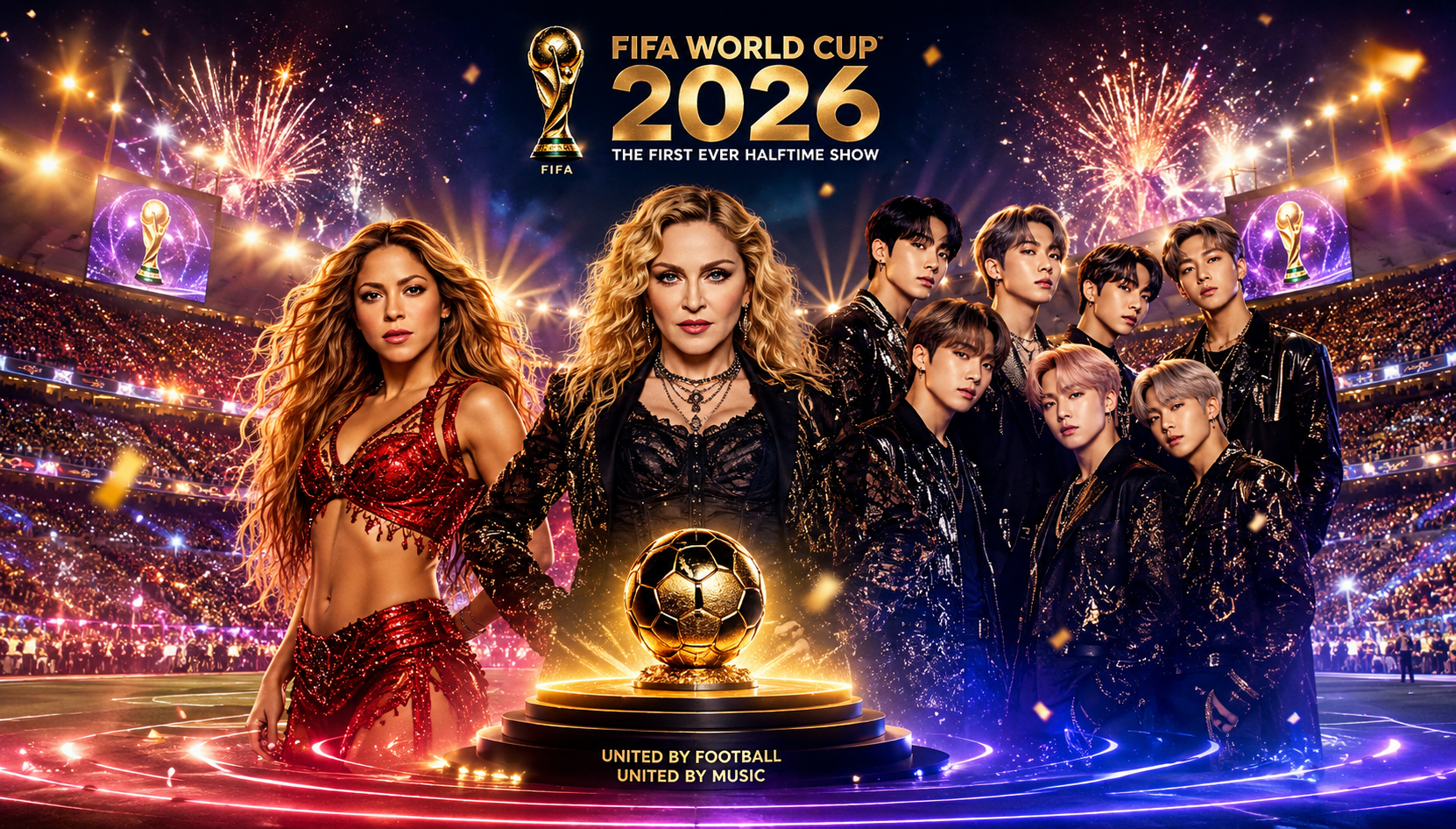
A cultural relic from the last era of global spectacle
There was a time when humanity still gathered in billions to watch a ball roll across grass.
And in that time, the world decided that even the biggest sporting event on Earth was not big enough anymore.
So they turned the World Cup Final into a concert.
The Announcement That Echoed Across the Old Internet
In the year 2026, when the planet was still humming with satellites and streaming platforms, FIFA revealed something that perfectly captured the spirit of the era:
The first ever Super-Bowl-style halftime show at a FIFA World Cup final.
This was not presented as an experiment.
It was presented as destiny.
The world had long watched the Super Bowl halftime show grow into a ritual of pop culture worship — a moment when sport paused so music could remind people who their gods were.
Now, the ritual would become global.
The World Cup final would stop mid-battle so the entire planet could watch a stage rise from the field.
The Chosen Icons of the Era
The performers selected were not random artists.
They were symbols of global pop culture at its peak.
Three names carried across every continent:
- Madonna
- Shakira
- BTS
Three different generations.
Three different continents.
Three different eras of fame — unified into a single broadcast moment.
This was not just a concert.
It was a message: global culture had become one giant stage.
Music, sport, celebrity, and mass media were no longer separate worlds.
They had fused into a single spectacle economy.
The Logic of the Spectacle Age
To people living at the time, this move made perfect sense.
Sport had already become entertainment.
Entertainment had already become branding.
Branding had already become identity.
The World Cup was the last giant untouched stage.
And in the 2020s, untouched stages were considered wasted potential.
Why let billions watch only football
when billions could watch everything at once?
The First Global Halftime Ritual
The halftime show had long been an American tradition — a moment of performance designed for television audiences as much as stadium crowds.
By 2026, the idea had evolved into something bigger:
A halftime show for the entire planet.
A single synchronized audience across time zones, languages, and cultures.
One performance broadcast everywhere.
A shared moment in a fragmented world.
What This Revealed About Humanity
To future readers, this moment says more about the people of that era than the performers themselves.
It reveals a civilization obsessed with:
- Scale
- Visibility
- Shared global moments
- And the fear of silence between events
Even halftime had to be filled.
There could be no empty space.
No pause.
No quiet.
Only spectacle.
The Meaning Behind the Music
The performers symbolized the final form of global celebrity:
Madonna – the enduring icon of pop reinvention
Shakira – the voice of global football culture
BTS – the internet-native supergroup of the streaming age
Together they represented the past, present, and future of fame.
Or at least, what the world believed fame would always be.
A Snapshot of What the World Loved
This article survives as a small fragment of what mattered to people before everything changed.
They loved football.
They loved music.
They loved shared global moments.
They loved the idea that billions of strangers could watch the same thing at the same time and feel connected.
Even if only for fifteen minutes.
The Halftime Show as a Time Capsule
Today, this announcement reads less like sports news
and more like a message in a bottle.
A reminder of what the world celebrated:
Stadium lights.
Streaming platforms.
Global icons.
And the belief that the show would never stop.
For a brief moment in history, humanity paused the biggest sporting event on Earth…
just to sing together.